
Section 18 consent explained
How section 18 consent works under WA's Aboriginal Heritage Act 1972: when you need it, the notice, the Minister's decision and review rights.
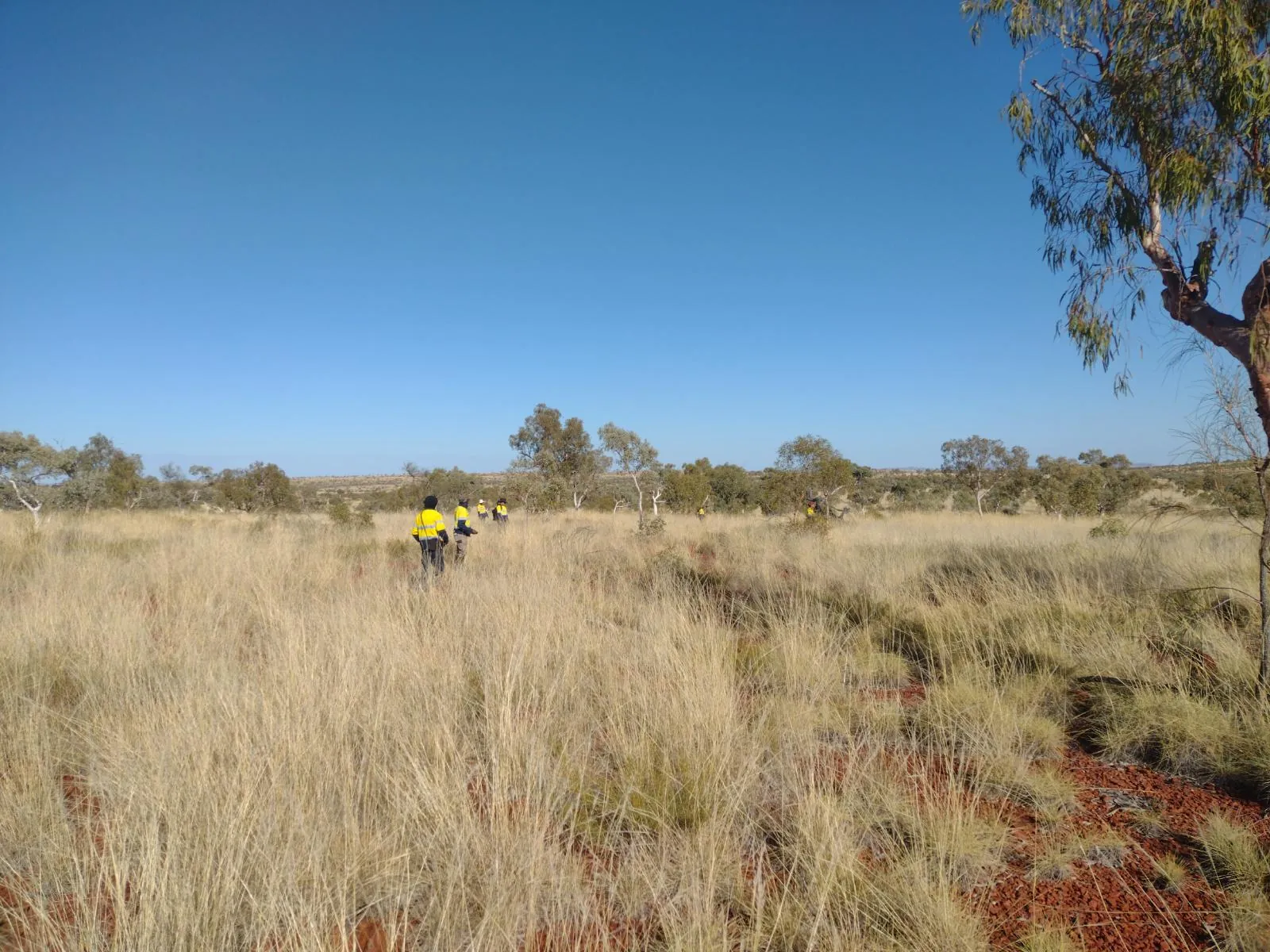
In Western Australia it is an offence to damage or alter an Aboriginal site without authorisation. If your project is likely to affect a site and you cannot avoid it, Section 18 of the Aboriginal Heritage Act 1972 is the main way to seek consent. The owner of the land gives a notice, the Aboriginal Cultural Heritage Committee makes a recommendation, and the Minister for Aboriginal Affairs decides. Consultation with the relevant Traditional Owners should start early, before a notice is lodged and ideally while the project can still change.
The process changed on 15 November 2023, when amendments made by the Aboriginal Heritage Legislation Amendment and Repeal Act 2023 took effect. Native title parties gained review rights, consents now carry a duty to report new information, and consents transfer with the land. This guide sets out how the process works as at October 2026. For help with a section 18 notice, see our heritage consultants in Perth.
What Section 18 is
Section 17 of the Act makes it an offence to excavate, destroy, damage, conceal or in any way alter an Aboriginal site without authority. The two forms of authority it recognises are an authorisation under section 16 and a consent under section 18(3)(a). Under section 57, a body corporate faces a maximum $50,000 fine for a first offence and $100,000 for a later one.
The Act protects all Aboriginal sites, not only those on the Register. DPLH's Aboriginal Heritage Act 1972 Guidelines (July 2026) say this includes sites the Department knows nothing about, and that unassessed "lodged" places should be treated as possibly covered.
Section 18 lets an "owner" of land ask the Minister for consent to use land in a way that would otherwise be likely to breach section 17. "Owner" is defined broadly. It includes freeholders, Crown lessees, holders of mining tenements and petroleum rights, and some pipeline, energy and water licence holders.
When you need a notice
You need a notice when your proposed use of the land is likely to breach section 17. The DPLH guidelines set out a three-step risk assessment:
- Assess the likelihood of an Aboriginal site being on the land.
- Consider the potential for harm to that site.
- Determine the nature and level of that harm.
If the project can avoid a site, consent may not be needed. Depending on the activity, a different approval may be enough:
- Section 16 authorisation. The Registrar of Aboriginal Sites, on the Committee's advice, can authorise excavation of a site or removal of things from it. This is usually for research or investigation.
- Regulation 10 consent. Under the Aboriginal Heritage Regulations 1974, certain acts on an Aboriginal site or protected area need written consent from the Minister or Registrar. Examples include disturbing the ground or cutting vegetation. DPLH uses this for minor works such as maintenance, fencing and remediation.
- Regulation 7 approval. Needed to bring digging or lifting equipment or explosives onto that land.
Our Section 18 notices and approvals work, part of our Aboriginal heritage consulting, starts by confirming which approval, if any, applies.
Start with early consultation with Traditional Owners
DPLH's Consultation policy for section 18 applications (November 2023) is clear on timing: "Before submitting a section 18 application, the landowner should consult with the relevant Aboriginal people." The policy uses the term "relevant Aboriginal people". In this guide we call them the relevant Traditional Owners. They include:
- The native title party for the area. This can be a regional corporation established under the South West Settlement or Yamatji Nation ILUAs, a registered native title body corporate (often called a PBC), registered native title claimants, or a body prescribed in the regulations.
- Other Aboriginal people with knowledge of the sites. People who have knowledge and rights in relation to Aboriginal sites in the area but are not members of the native title party.
DPLH can advise on other relevant Aboriginal people for an area who are not members of the native title party.
Why early matters
The policy says early engagement and consultation "can help identify ways to minimise and avoid harm to, or disturbance of, Aboriginal sites, including potentially removing any need for a section 18 consent". That is easiest while the project's location, layout and methods can still change.
It also gives the relevant Traditional Owners the opportunity to share their knowledge and views, and to have them considered, before decisions are fixed. Starting early leaves room for the "sufficient time for genuine consultation" the policy asks for, and for planning any heritage survey with the people who hold knowledge of the area.
Timing affects the assessment too. If consultation in line with the policy has not been done, the Minister or the Registrar of Aboriginal Sites may defer a decision until it has. The Committee may also seek information directly from relevant Aboriginal people.
What good consultation looks like
Section 5 of the policy sets seven standards. Together they describe consultation that is fully informed, two-way, culturally appropriate and given enough time.
| Standard | What it means in practice |
|---|---|
| Full disclosure | Share all information relevant to the application about possible impacts on Aboriginal heritage, such as sites or objects. |
| Feasible alternatives | Explain any feasible alternative locations or methods for the project that may have lower impacts on sites or objects. |
| A chance to respond | Give the people consulted the opportunity to respond, consider their response, and tell them whether and how it has been addressed. |
| Knowledge of sites | Seek knowledge of the location, significance and importance of sites and objects in the area, recognising that some information may not be appropriate to share or record for cultural reasons. |
| Respect for protocols and time | Respect traditions, cultural protocols and obligations. Take reasonable steps to make contact, for example by phone and email, and allow enough time for responses. |
| Culturally appropriate space | Provide a culturally appropriate space for exchanging information, and ask the people being consulted what culturally appropriate consultation looks like. |
| Consultation framework | Where the people being consulted ask for one and it is practicable, agree a framework covering communication methods, timeframes, meetings and response times. |
What goes into a notice
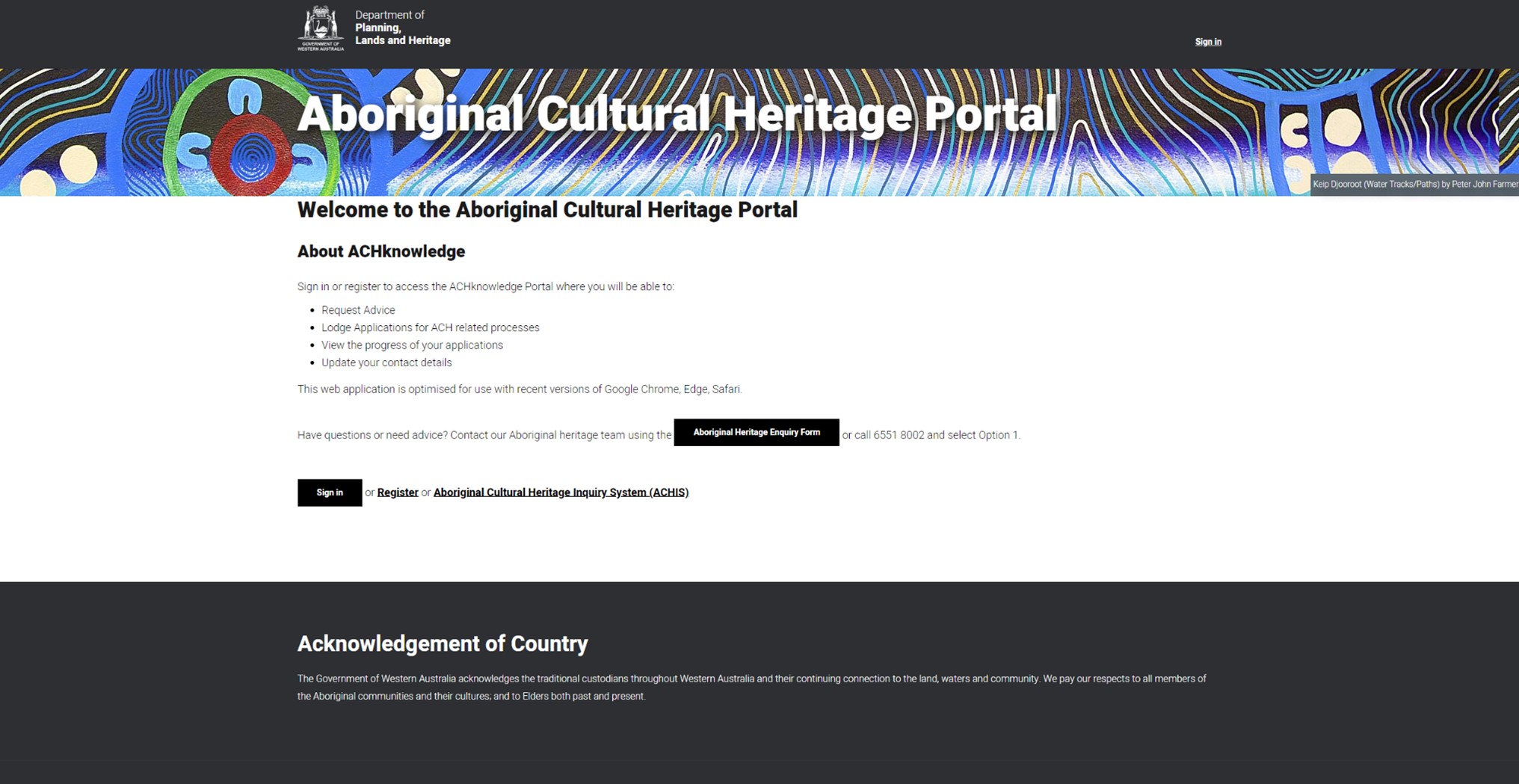
Notices are lodged through DPLH's ACHknowledge portal. The applicant must be the landowner or someone authorised by them. Agents must attach the landowner's signed Authority Form. DPLH strongly encourages a pre-lodgement discussion with its Aboriginal heritage officers.
Where relevant, a notice must include:
- owner and applicant details, with evidence of authority where needed
- maps and a clear description of the project and the purpose of the land use
- final Aboriginal heritage survey reports (draft reports are not accepted)
- details of newly recorded sites and new information about existing sites
- spatial data for the land and each site (shapefiles in GDA94)
- details of consultation with Aboriginal people
- the potential harm and how it will be avoided, minimised or managed
Consultation with the relevant Traditional Owners should already have happened, as set out above. The notice should include evidence of it, such as correspondence, meeting minutes, presentations and survey reports. If consultation could not be completed despite good-faith attempts, DPLH asks proponents to contact it for advice on how to proceed.
Fees are set by the Aboriginal Heritage (Fees) Regulations 2023 and reviewed annually. As at July 2026, DPLH lists a $262 application fee, plus $8,620 per identified site or place for commercial and government proponents. Individuals, small businesses and not-for-profit organisations pay the $262 application fee only.
How a decision is made
Under section 18(2), the Aboriginal Cultural Heritage Committee forms an opinion on whether there is an Aboriginal site on the land. It then evaluates the site's importance and significance and sends the notice to the Minister with a written recommendation. The Committee replaced the former Aboriginal Cultural Material Committee in November 2023. DPLH describes it as having a majority of Aboriginal members and male and female Aboriginal co-chairs.
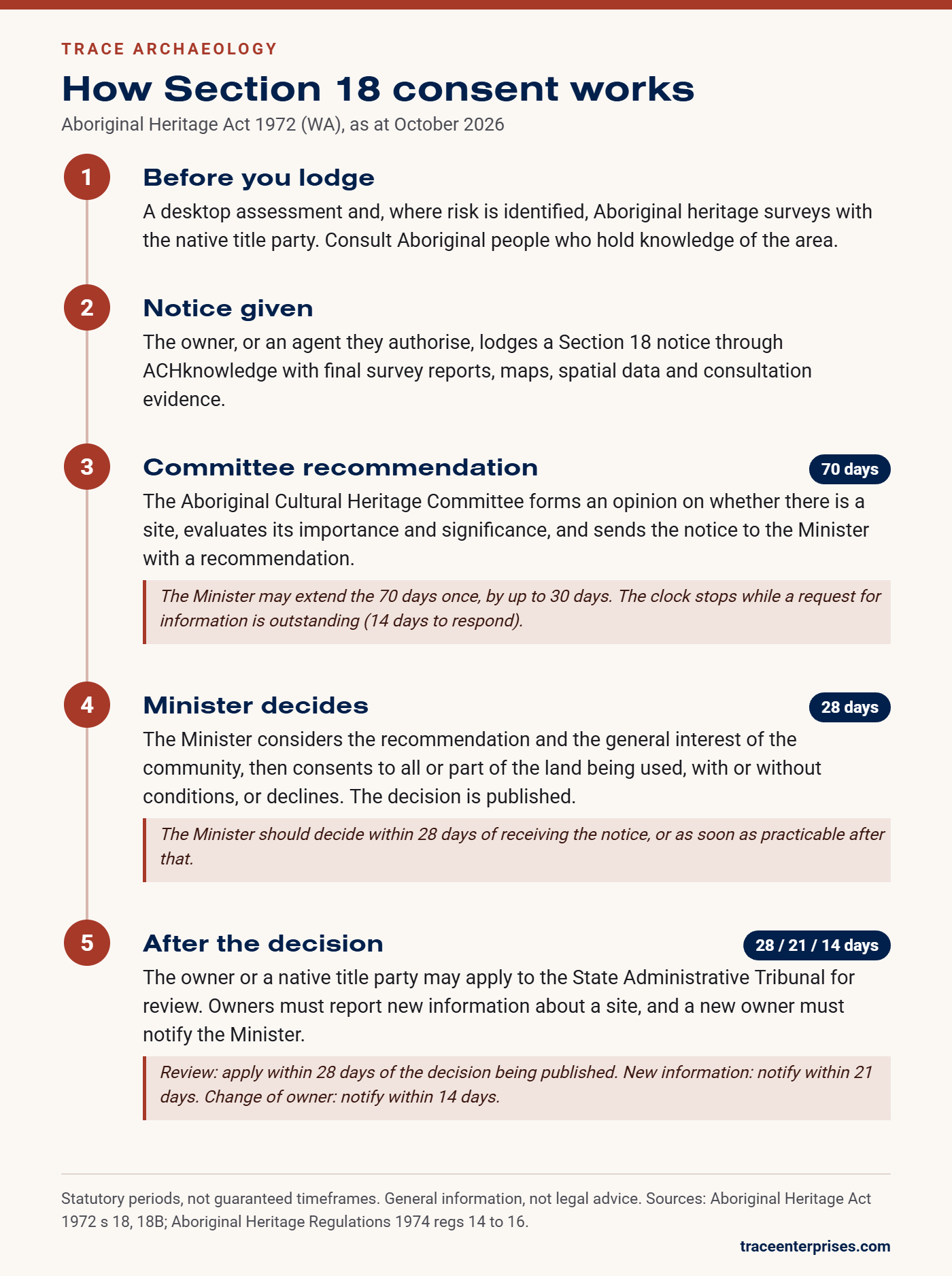
Regulation 14 sets the statutory periods:
- The Committee must submit the notice to the Minister within 70 days of it being given.
- The Minister may extend that period once, by up to 30 days.
- If the Committee asks for more information, the owner has 14 days to respond. Days spent waiting on a request do not count towards the 70 days, but only up to the time the owner is allowed to respond.
- The Minister should decide within 28 days of receiving the notice, "or as soon as practicable after that".
These are statutory periods, not guaranteed timeframes.
The Minister considers the Committee's recommendation and the general interest of the community. Under section 18(3), the Minister may consent to all or part of the land being used, with or without conditions, or decline consent. The decision is published on the DPLH website (section 18(3A)).
Conditions and the duty to report new information
Conditions can deal with sites or objects, mitigation measures and how the land is used. Section 18(8) provides that work done under a consent and in line with its conditions is not an offence. Work outside the consent or its conditions has no such protection.
Since the 2023 amendments, every Section 18 consent carries a new-information condition under section 18(6). This includes consents given before 23 December 2021. If the owner becomes aware of new information about an Aboriginal site on the land, they must notify the Minister through ACHknowledge within 21 days (regulation 16). The Minister must then confirm, amend or revoke the consent, or revoke it and consent again. The Minister may suspend the consent while deciding.
Consents now transfer with the land under section 18B. A new owner must notify the Minister within 14 days of the change in ownership.
Site inductions, monitoring and a clear process for reporting finds help owners meet these obligations. A cultural heritage management plan is a common way to set this up.
Rights of review
Under section 18(5), the owner or a native title party may apply to the State Administrative Tribunal (SAT) to review the Minister's decision. The application must be made within 28 days of the decision notice being published (regulation 15). Contract terms that try to stop a native title party from seeking review have no effect (section 18(5A)).
Section 18A lets the Premier call in a review application that raises issues of State or regional importance.
What changed in 2025 and 2026
The State commissioned a targeted review of native title and Aboriginal cultural heritage processes in 2025. National Native Title Tribunal Member Glen Kelly facilitated it, and it is often called the Kelly Review. The final report was delivered on 9 February 2026 and tabled in Parliament on 9 June 2026.
The Government does not intend to amend the Aboriginal Heritage Act 1972 in response. It has committed to:
- piloting a mediation service available before a Section 18 application is lodged
- a voluntary code of conduct and certification scheme for heritage consultants
- a new Aboriginal cultural heritage standard for exploration and prospecting
The Department of the Premier and Cabinet has since published an implementation timeline, and on 14 September 2026 the Minister for Aboriginal Affairs announced a chair for the Native Title and Heritage Standards Working Group. We cover the timeline in The Kelly Review: what changes for heritage surveys in WA, and when. DPLH also republished its Act guidelines in July 2026.
How it fits with due diligence and surveys
A Section 18 notice usually starts with a due diligence desktop assessment. That includes searching the Aboriginal Cultural Heritage Inquiry System (Register and Lodged layers, plus its survey directory) and reviewing past reports.
Where risk is identified, Aboriginal heritage surveys with the native title party record archaeological and ethnographic values. They also produce the final reports and much of the consultation evidence a notice needs. Results often show whether a site can be avoided.
How Trace Archaeology helps
Trace Archaeology's archaeologists and anthropologists act as Section 18 agents for developers, miners, explorers and government across WA. We:
- plan and support early consultation with the relevant Traditional Owners, alongside desktop assessments and surveys
- assess risk and confirm which approval applies
- run desktop assessments and field surveys, and document consultation
- prepare and lodge notices through ACHknowledge and answer Committee requests
- help manage conditions and new-information reporting after consent
Decisions rest with the Committee and the Minister, so no consultant can promise an outcome or timeframe. Our job is to put a complete, well-evidenced notice in front of them.
This article is general information, not legal advice. Get advice for your own project before acting on it.
For background on how the 1972 Act was restored, read The new old Act: Aboriginal Heritage Act 1972. To talk about a project, contact us.
Frequently asked questions
Do I need Section 18 consent if there is no registered site on my land?
Possibly. The Act protects all Aboriginal sites, whether or not they are on the Register. DPLH's guidelines ask landowners to assess the likelihood of a site being present, which usually means a desktop assessment and sometimes a survey. If a site is likely and harm cannot be avoided, consent or another approval may be needed.
Do I need to consult Traditional Owners before lodging a Section 18 notice?
Yes. DPLH's consultation policy says the landowner should consult the relevant Aboriginal people before submitting a section 18 application. That means the native title party for the area and other Aboriginal people with knowledge of the sites, and DPLH can advise on who else is relevant. If consultation in line with the policy has not been done, the Minister or Registrar may defer a decision until it has.
How long does a Section 18 decision take?
The regulations give the Committee 70 days to submit the notice to the Minister, extendable once by up to 30 days. The Minister should then decide within 28 days or as soon as practicable. The 70-day period pauses while an information request is outstanding, up to the time allowed to respond, so actual times vary.
Who can challenge a Section 18 decision?
The owner or a native title party can apply to the State Administrative Tribunal within 28 days of the decision being published. Native title parties gained this right when the 2023 amendments took effect. The Premier can call in a review on matters of State or regional importance.
What happens if new information about a site comes to light after consent?
The owner must tell the Minister through ACHknowledge within 21 days of becoming aware of it. The Minister must then confirm, amend or revoke the consent, or revoke it and consent again. The consent may be suspended in the meantime.
References
- Aboriginal Heritage Act 1972 (WA), consolidated version as at 28 May 2026 (04-n0-00). legislation.wa.gov.au
- Aboriginal Heritage Regulations 1974 (WA), consolidated version as at 16 March 2026 (03-a0-00). legislation.wa.gov.au
- Aboriginal Heritage Legislation Amendment and Repeal Act 2023 (WA), No. 23 of 2023. legislation.wa.gov.au
- DPLH, Aboriginal heritage approvals (updated 1 July 2026). wa.gov.au
- DPLH, Aboriginal Heritage Act 1972 Guidelines (July 2026). wa.gov.au
- DPLH, Consultation policy for section 18 applications (November 2023; who to consult, timing and the good-practice standards in section 5). wa.gov.au
- DPLH, Aboriginal Heritage Act 1972 (Aboriginal heritage laws page, updated 10 March 2026). wa.gov.au
- DPLH, Aboriginal Cultural Heritage Committee (updated 9 October 2026). wa.gov.au
- DPLH, ACHknowledge portal. wa.gov.au
- DPLH, Find Aboriginal cultural heritage in WA (updated 27 March 2025). wa.gov.au
- Department of the Premier and Cabinet, Native Title and Cultural Heritage Processes Review (updated 23 June 2026). wa.gov.au
- G Kelly and S Clark, Review of Native Title and Heritage Processes in Western Australia (9 February 2026). wa.gov.au
- WA Government media statement, "Targeted review of Native Title, cultural heritage processes released" (9 June 2026). wa.gov.au
- Department of the Premier and Cabinet, Native Title and Aboriginal Cultural Heritage Processes Review: Government response to recommendations (8 June 2026). wa.gov.au
Other latest news















Talk to our team
Our archaeologists, ecologists and town planners can tell you what this means for your site.