
What's actually being proposed
The Residential Design Codes (the R-Codes) set the rules for residential development across Western Australia. They determine how many dwellings a block can hold, how big those lots have to be, how far buildings sit from boundaries, and how much open space and parking is required. The reforms announced by Planning and Lands Minister John Carey on 2 July 2026 cover four main areas.
The average lot size requirement goes
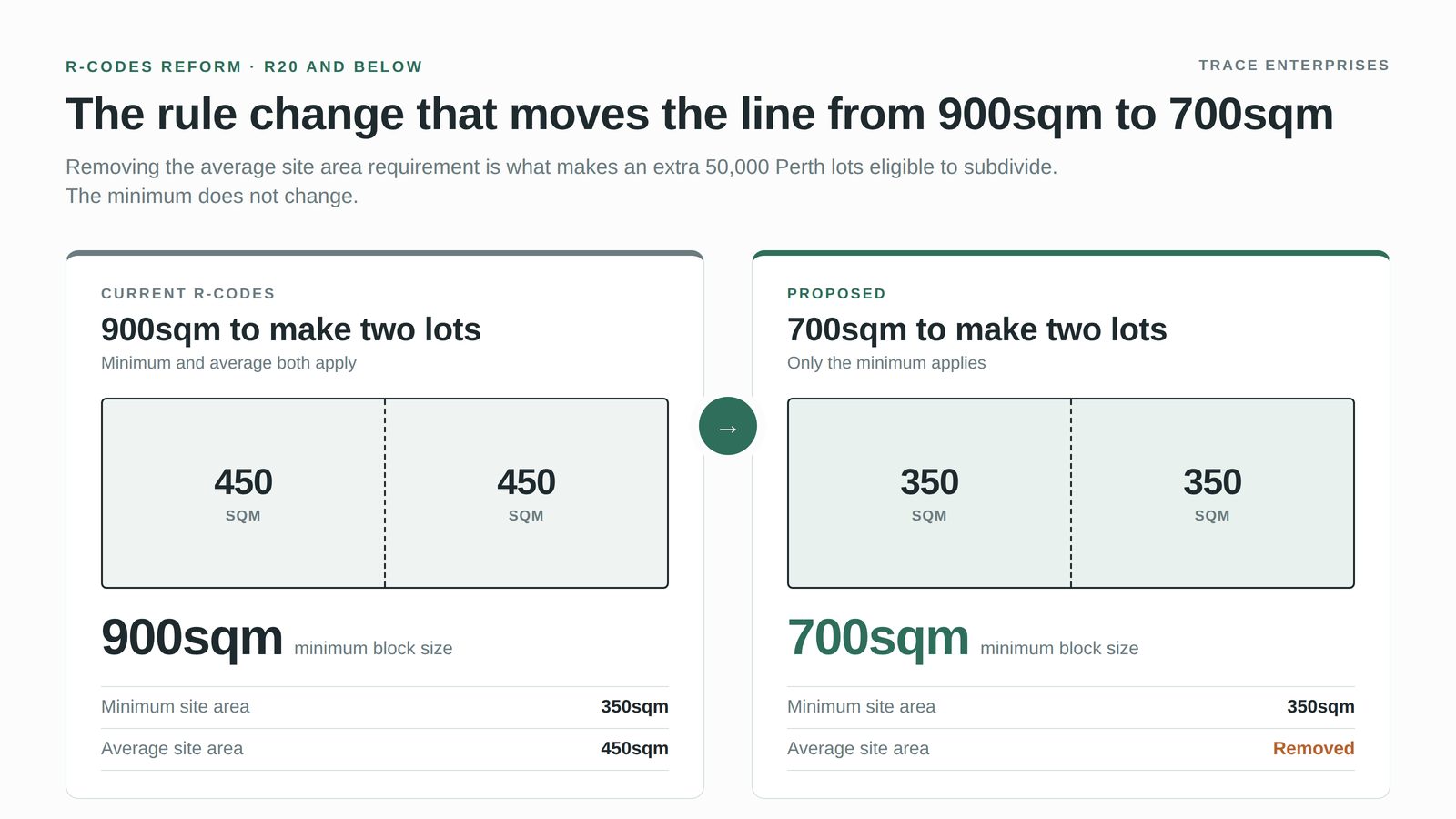
This is the change driving the 50,000 figure, and it is worth understanding properly because the arithmetic is not obvious. Under the current R-Codes, an R20 block has two numbers attached to it: a minimum site area of 350sqm and an average site area of 450sqm. To create two lots, both have to be satisfied. Neither lot can fall below 350sqm, and the two together have to average 450sqm. In practice that means you need a block of at least 900sqm to get two titles out of it.
The proposal removes the average site area requirement for R20 and below. Only the minimum survives. Two lots at 350sqm each means the threshold falls from 900sqm to 700sqm, and nothing else about the R20 site area rules changes.
That 200sqm difference is where the 50,000-plus figure comes from. A very large number of Perth blocks sit in the 700–899sqm band: the standard quarter-acre subdivided once in the 1970s and 80s, or the slightly-under-900 lot that has frustrated owners for years.
Three storeys in R40 areas
Medium-density R40 zones are proposed to allow three storeys as a baseline rather than two. Baseline heights across medium and high-density codes are being redefined more broadly as part of the same work.
Parking minimums removed for apartments and ancillary dwellings
Minimum parking requirements would be scrapped for apartments and granny flats, leaving the number of bays to the market and the site rather than a fixed ratio.
Fewer approvals, faster approvals
Simple residential work, such as single houses, renovations, patios and carports, would no longer need development approval at all in many cases. Where approval is still required for a single dwelling, the statutory timeframe would halve from 60 days to 30.
When does any of this take effect?
Not yet, and not soon. As of September 2026, the reforms are proposals being refined by the Western Australian Planning Commission with an advisory group of local government, industry, planning and architecture representatives. Public consultation is expected to open later in 2026, with details to be published on the Department of Planning, Lands and Heritage’s Have Your Say platform. Implementation is anticipated for mid to late 2027, subject to consultation and approval. The Department’s own review page gives that range; some media coverage has reported July 2027, which is the earlier end of it.
Until then, every subdivision and development application in Western Australia is assessed under the framework that exists today. If your block is 780sqm and zoned R20, the WAPC will refuse it this year for the same reason it would have refused it last year.
That is not an argument for sitting on your hands. It is an argument for using the next twelve months to find out whether your block will actually work when the rules do change, because lot size is only the first hurdle.
Eligible is not the same as approved
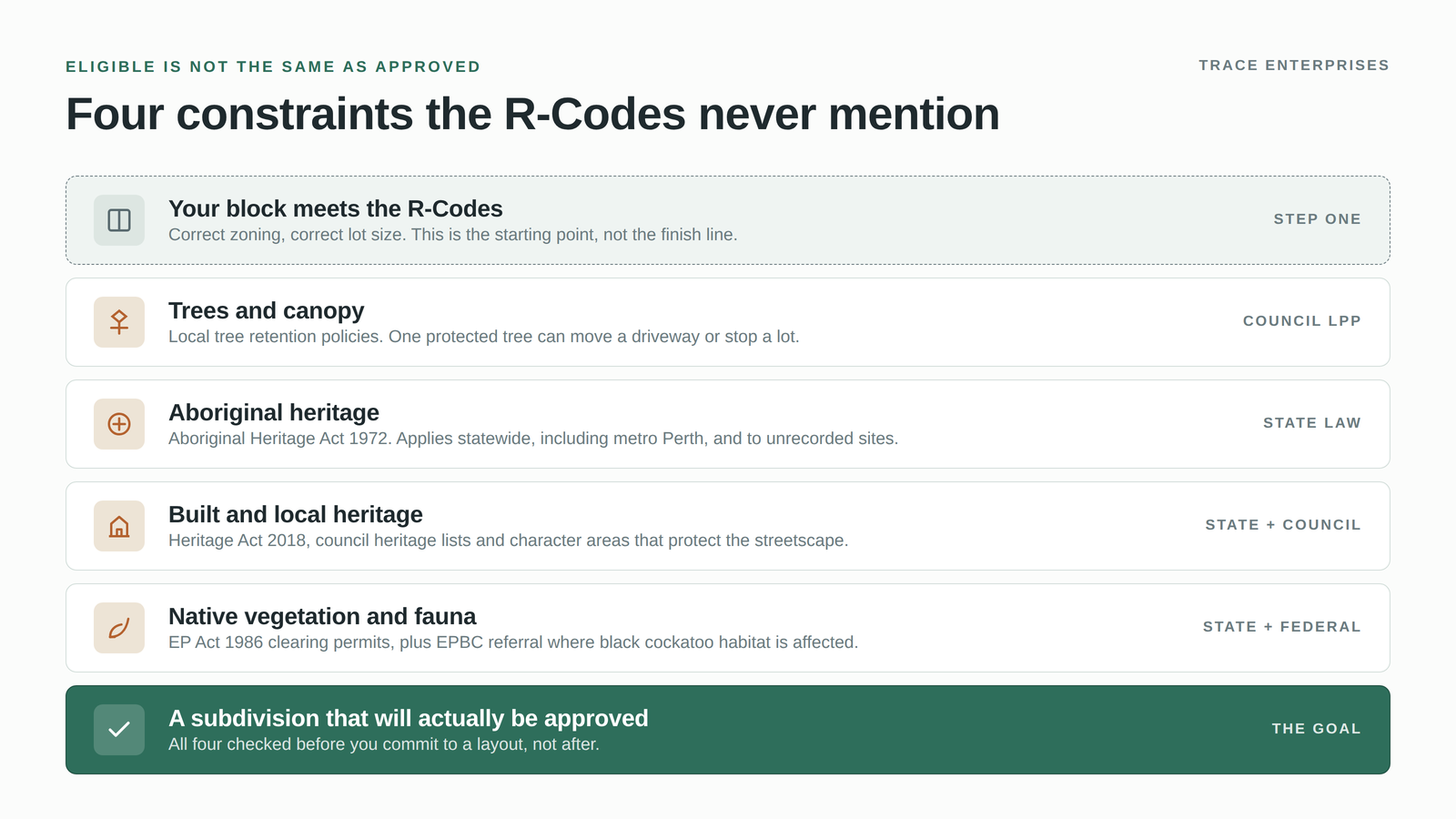
This is the part that gets lost in the headlines, and it is the part that costs people money. The R-Codes tell you whether a subdivision is permissible. They do not tell you whether it is achievable. A block can hit every number in the code and still fail at the WAPC, or clear subdivision and then stall for eighteen months at the clearing-conditions stage. We see it regularly.
Four categories of constraint sit outside the R-Codes entirely, and none of them are touched by these reforms.
Trees and canopy
Perth’s tree canopy has been shrinking for two decades, and local government has noticed. WALGA has published a model Local Planning Policy on tree retention, and councils across the metro area, among them the Town of Claremont, the City of South Perth and the Shire of Serpentine Jarrahdale, have adopted or are consulting on their own versions.
These policies typically protect trees above a nominated trunk diameter, height or canopy spread. They bind the council at development approval stage, and they inform the conditions the WAPC imposes when it approves a subdivision. A single mature tuart or marri sitting where your battle-axe driveway needs to go can force a redesign, an offset planting requirement, or a refusal. An arboricultural assessment early in the process tells you which trees are negotiable and which are not.
There is a real tension here that the reform debate has not resolved. More infill on smaller lots means more hardstand and less room for canopy, at the same time as councils are tightening tree protection. Expect the two policies to collide on individual sites, and expect the site-specific arguments to matter.
Aboriginal heritage
The Aboriginal Heritage Act 1972 (WA) applies to every landholder in this state. It is not restricted to the Pilbara, it does not stop at the metropolitan boundary, and it applies whether or not a site is on a register.
That last point is the one that catches people. The Register of Places and Objects, searchable through the Aboriginal Cultural Heritage Inquiry System, is not a complete record. It reflects what has been reported and assessed, not everything that exists, and DPLH has an ongoing program to survey high-priority areas that have never been looked at. In our experience, sites near watercourses, wetlands and the Swan Coastal Plain’s remnant dune systems turn up more often than most Perth landowners expect.
Disturbing a site without a Section 18 consent is an offence. Ignorance on its own is not a defence; demonstrable due diligence is.
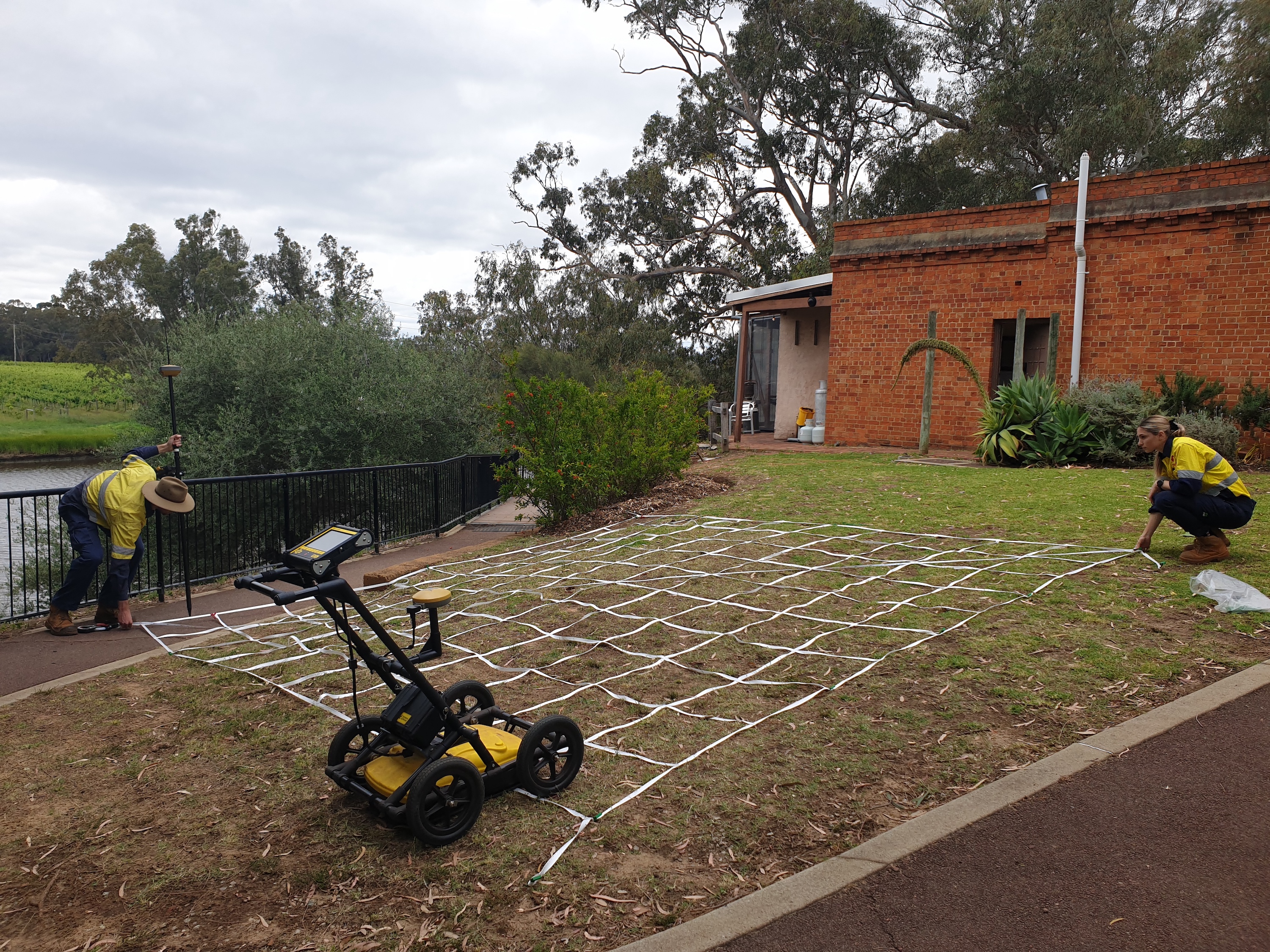
For most metropolitan blocks a due diligence desktop assessment resolves the question quickly and cheaply. Where the desktop review flags risk, an Aboriginal heritage survey or ethnographic consultation with the relevant Traditional Owners is the next step. Both are far less painful than a stop-work order after the excavator arrives.
Built and local heritage
Separately from Aboriginal heritage, your block may carry obligations under the Heritage Act 2018 (WA) or your local government’s heritage list and Local Planning Scheme.
Character areas are the sleeper here. A dwelling does not need to be individually listed for a subdivision to be refused. Many councils have heritage or character precincts where the streetscape pattern itself is protected, and a battle-axe lot behind a 1920s bungalow reads as an intrusion. If your block sits in an established western or inner-northern suburb, check the local heritage survey before you spend anything else. A heritage impact statement or character assessment is often what turns a refusal into a conditional approval.
Native vegetation and protected fauna
Clearing native vegetation in WA requires a permit under the Environmental Protection Act 1986 unless an exemption applies. Exemptions exist for many urban situations, but they are narrower than people expect and they are not automatic.
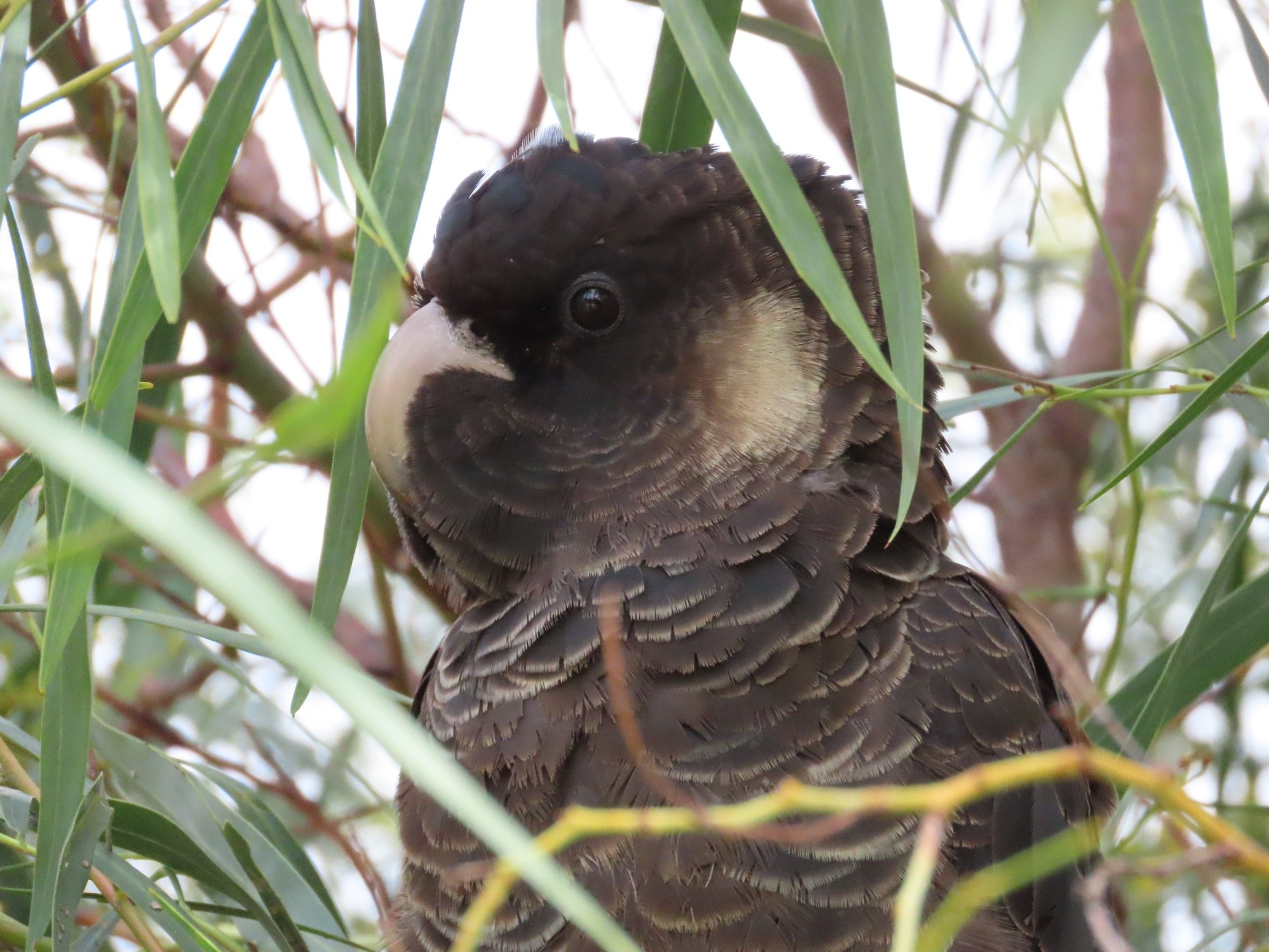
Add to that the Commonwealth EPBC Act 1999. Perth sits inside the range of three threatened black cockatoo taxa (Carnaby’s, Baudin’s and the forest red-tailed), and their listed habitat includes foraging vegetation and hollow-bearing trees on suburban and peri-urban land. Where a proposal has a significant impact on a listed species, a federal referral is triggered regardless of what the state approves. A flora and fauna assessment determines whether you are in that territory before you commit to a layout.
For blocks on the urban fringe or in the Hills, add servicing to the list: sewer connection, effluent disposal, bushfire attack level, and legal access can each be the thing that decides the outcome.
What to do between now and mid-2027
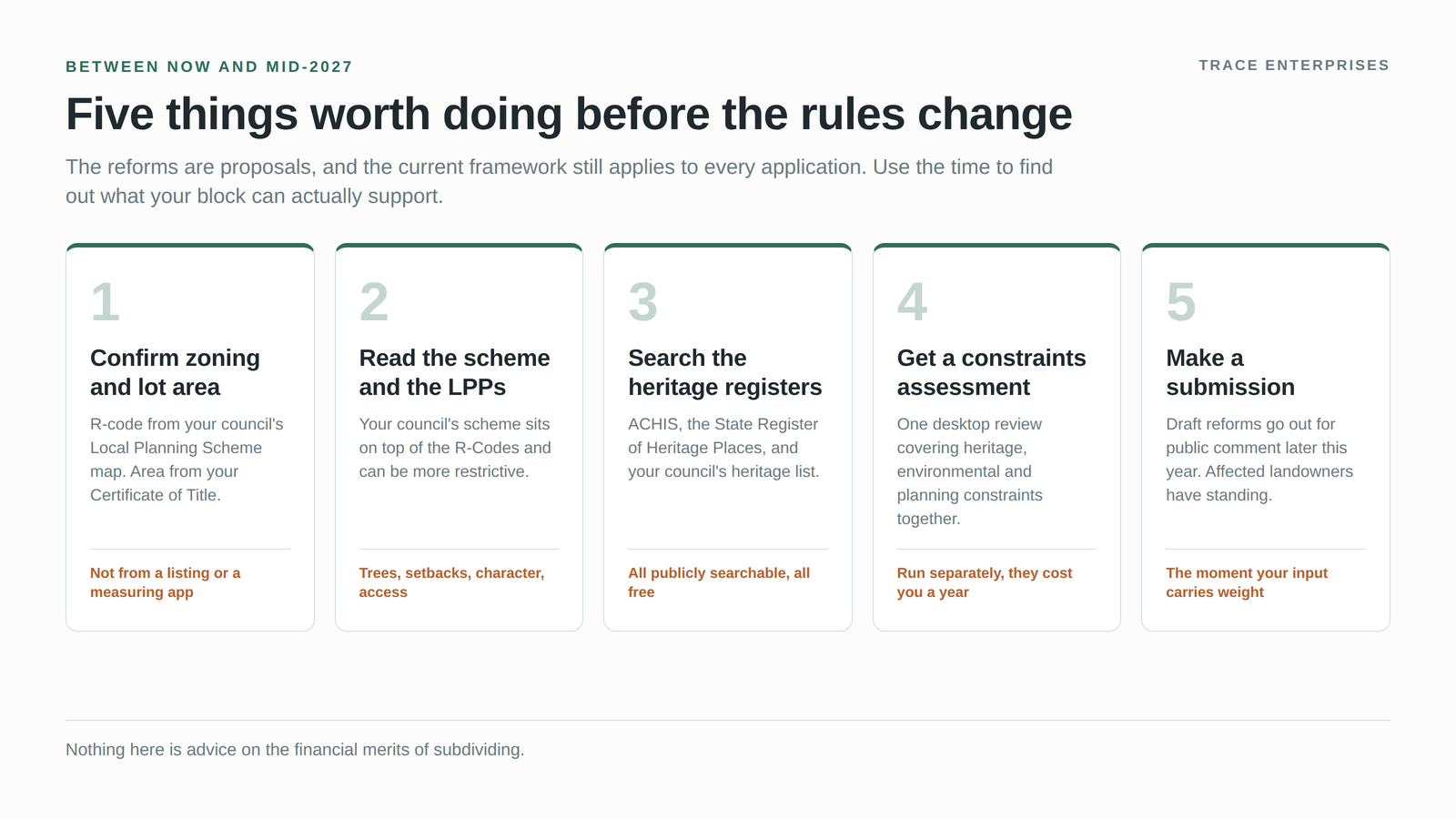
If you think your block is one of the 50,000, five things will tell you more than any amount of speculation.
Start by confirming your zoning and lot area. Get the R-code from your local government’s Local Planning Scheme map and the exact area from your Certificate of Title, not from a real estate listing or a measuring app. A block you have always been told is “about 800 square metres” is worth checking properly.
Then read the scheme and the local planning policies. The R-Codes are the state framework. Your council’s scheme and its local planning policies sit on top of it and can be more restrictive, particularly on trees, setbacks, character and access.
Search the heritage registers next. Check the Aboriginal Cultural Heritage Inquiry System, the State Register of Heritage Places, and your local government’s heritage list and municipal inventory. All are publicly searchable, and all are free.
After that, get a constraints assessment. One desktop review covering heritage, environmental and planning constraints together will tell you where the real risks sit. Running the three separately, months apart, is how projects lose a year.
Finally, make a submission when consultation opens. Draft reforms go out for public comment later this year. If you own affected land, or you have a view on how tree retention and infill should interact, that is the moment your input carries weight.
A note on expectations: these are proposals. Consultation exists precisely because outcomes can shift, and the final position on lot sizes may not match what was announced in July. Plan on the basis of what your block can support, not on the basis of a policy that has not been finalised. Nothing in this article is advice about the financial merits of subdividing. That is a conversation for you and your own advisers.
Where Trace fits
We are a multidisciplinary consultancy. Heritage, environment and planning sit under one roof, which means a constraints assessment on your block is one piece of work by one team, not three quotes and three timelines that do not talk to each other.
We have run this process across the Perth metropolitan area, the Wheatbelt, the South West and the state’s north, for landowners with a single block and for developers with a pipeline. We will tell you when a site does not work, which is usually the cheapest advice you will get all year.
If you own a block between 700 and 900 square metres and you want to know what it can actually support, get in touch at office@traceenterprises.com
Frequently asked questions
Can I subdivide a 700sqm block in Perth right now?
Not under the current R-Codes if it is zoned R20 or below. Today an R20 block needs a minimum of 900sqm to create two lots, because both the 350sqm minimum site area and the 450sqm average site area must be met. The proposed reforms remove the average requirement, which would bring the threshold to 700sqm, but they are not expected to take effect until mid to late 2027.
When do the R-Codes changes take effect?
Public consultation on the draft reforms is expected in late 2026, with implementation anticipated mid to late 2027, subject to consultation and approval. Until then, all applications are assessed under the existing framework.
Which R-codes are affected by the lot size change?
The removal of the average site area requirement applies to R20 and below, the low-density codes covering most of Perth’s established suburbs. Separate changes are proposed for R40 and above, including three storeys as a baseline in R40 areas.
Do I need a heritage assessment to subdivide in the Perth metro area?
The Aboriginal Heritage Act 1972 applies statewide, including metropolitan Perth, and applies to unrecorded sites as well as registered ones. A due diligence desktop assessment is the standard first step, and it is also what supports the statutory defence, if a site is later found. Your block may also carry obligations under the Heritage Act 2018 or your local government’s heritage list.
Will the reforms make it easier to remove trees for a subdivision?
No. Tree protection sits in local planning policies, not the R-Codes, and those policies are getting stronger rather than weaker. Several Perth councils have adopted or are consulting on tree retention policies based on the WALGA model policy.
What is the difference between minimum and average site area under the R-Codes?
Minimum site area is the smallest a single resulting lot can be. Average site area is the figure all resulting lots must average across the subdivision. Both currently apply, which is why an R20 block needs 900sqm rather than 700sqm to yield two lots.



.JPG)